Showing posts with label Linn LP12. Show all posts

Thursday, August 2, 2012

Audiophilia Nervosa

"Audiophilia Nervosa" is a terminology used on audiophiles who constantly upgrade their gears and it would indeed be a sin if our relentless pursuit is in hifi gears rather than music!

I set up my first serious hifi system in 1992 that has seen countless upgrades since (prior to that, I only had stereo receiver and self-assembled loudspeakers). Twenty years down the road, my system should have matured and I should also have mustered enough experiences to mock audiophilia nervosa friends with the "... been there, done that" phrase but fact is I am equally guilty of committing the very same sin myself - an aspect that I am not proud of. As audiophiles, we tend to justify our actions; this blog posting is on some recent updates to my system and my justifications in performing them.

After owning a Linn LP12 turntable, I sought to own a Naim amplifier next and voice my system closer to a 'flat-earth' system with greater emphasis on timing. I fulfilled this aspiration by acquiring a Nait XS - an integrated amp instead of pre/power models as I favour minimal box count, lesser cables and I have modest means. The danger of owning Naim amps is the ensuing addition of matching source components and/or external power supplies to adhere to Naim's design philosophy. Then there are upgrades to higher-up models. I shall strive hard to steer clear of such path but I digress.

Nait XS has many 'round-earth' sonic properties, is greener with its lower power consumption (biased to class B) and has better electrical properties to drive my rather 'lazy sounding' Sonus Faber Concerto Home loudspeakers better than Simaudio Moon i-3 although the latter amp is more powerful, sounds sweeter and fuller, throws a deeper yet more holographic soundstage. Simaudio Moon i-3 is a better amp overall and makes an ideal partner to 'brighter sounding' loudspeakers such as ProAc and B&W, IMO. What Nait XS excels in are it is slightly more revealing, leaner, has better dynamics, more rhythmic thrusts to music and a better boogie factor - not exactly neutral per se but certainly more exciting to listen to. Listening to 16 bits/44.1 kHz Redbook CDs with my Roksan Caspian m1 CD player is excellent that simple Beethoven piano sonatas from the Romantic era sound captivating and alluring. It made me listened to the entire Naxos CD even in an off-axis position slumped on my couch after a tiring day at work. A CD that stands out is 苏芮's HQCD especially track 14 (一样的月光), a live rendition at A-Mei's concert that some folks may find annoyingly noisy. Her singing and backing instruments are furiously fast-paced and full of energy. Cranking up the volume knob on my Nait XS gave me the thrill as though I was right at her life performance myself. Awesome!

How about music of an entirely different genre? Listening to my 中国古筝十大名曲CD, a Marco Polo label under Naxos, had me fooled - as though I was listening to a 'transparent sounding' single-ended tube amp - completely devoid of electronic glare and mechanical edginess. It was that convincing that I was in the mood to brew some 龙井茶 green tea to complete the whole listening experience. I love Nait XS for how it sounds in my system; it is also much more versatile and more coherent sounding than its pre/power siblings and has rather unconventional vdH Integration interconnects and short length of Kimber 4TC speaker cables for company right now.

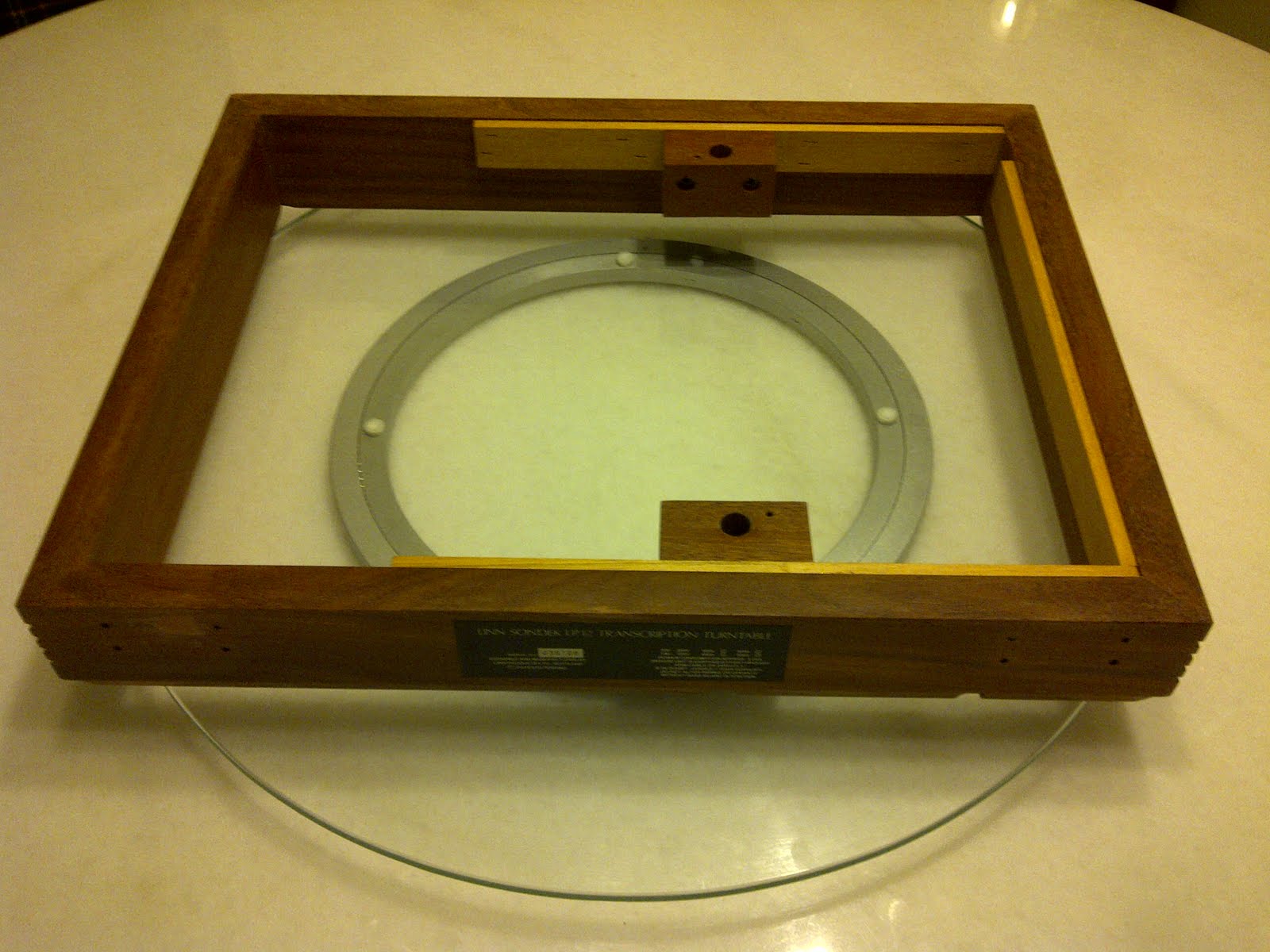
I listened more to CDs while vinyl playback in my system took a back seat pending arrival of the new fluted walnut plinth with ebony mounting blocks from Woodsong Audio. The plinth is superbly crafted (with build quality surpassing those of new Linn plinths) and has strong wood characters. The corner brace below the tonearm pivot has been specially milled for my RB700 tonearm, done beautifully. I love hard wood furniture, hence a beautiful vintage plinth for my LP12 is quite a must apart from the sonic improvements it imparts.

There are a plethora of aftermarket parts out there, all claiming to improve sonic performances of LP12 but the only item that I am keen in acquiring is a better designed subchassis. The stock steel subchassis with 'lossy-fitting' to Linn armboard is quite a compromise and masks details / bass of LP12 (my former Rega P5 fitted with a Groovetracer subplatter was ahead in such areas). I settled for Audio Innovation Sole V subchassis 'tightly-bolted' to Linn armboard by "Stealth Method" over the numerous alternatives in Linn Keel, GS Audio Klone, AudioFlat Rubikon, Vivid acrylic unit and Funk Firm Charm. My decision was based on John R's sonic preferences which I could identify with and its relatively more affordable price over all others.

Sole V is gorgeous and a real eye candy to behold! My search for new black PoziDriv wood screws at the local fastener shops was futile, hence I re-used the 30 years' old screws but not before giving them a thorough wash and scrub in the rebuilding of my ultimate LP12. I spent many hours at it, paying attention to details and having to run over to CM's place to seek his help to carefully drill-out 3 stubborn Allen screws from my pre-Cirkus bearing flange and completed the rebuild late Sunday evening.

The first record that I spun after the rebuild is Stan Getz's Anniversary LP. I perceived a huge soundstage with greater depth. Instruments sound organic and very vivid that Stan Getz's saxaphone literally jumped out from the Sonus Fabers right into my living room. Dynamics, both macro and micro, are more pronounced whereas tone, timbre and resolve improved significantly. Bass gained weight and details. I would summarise that the stock steel subchassis practically held back all areas of performance whereas Sole subchassis allows more music through without imposing sonic characters of its own. My LP12 now has soul and I love it.
 
I am justifying that the recent updates to my system are essential for me to enjoy my music. Individually, my hifi gears may not be the most accurate sounding but as a system, it plays music beautifully and evokes emotion in me. On the other hand, I do feel guilty when I went ahead with the purchases each time, a telling sign that my hard-earned money could be put to better use elsewhere. Perhaps I should have done that and remain contented listening to my small Rotel system in the bedroom!

Wednesday, July 27, 2011

My LP12 saga continues


The truth is I became very fascinated with LP12 ever since I owned one (or was it before I even had one) that I spin it several hours a day to play music. It sounds so addictively captivating to me that it makes me sit down wanting to listen closely, draws me deeper into the music and enables me to understand complex pieces better. Consequentially, my collection of records grows just as quickly and I stopped listening to CDs for quite a while now. There is simply no urge to, at least for the time being.

The aesthetic appeal (visual feel) of my hifi gears is of paramount importance to me, so apart from sounding good (aural feel), my LP12 must look its part too and my vanity led me to acquire a newer unit couple of years younger and in such an excellent condition that its plinth, main and sub platters are almost flawless. I have also picked up few other near-mint used parts and such actions incurred me card interests and losses when I eventually passed on the duplicated items to their respective new owners.

The plinth is an untouched fluted Afromosia or African Teak that has very beautiful grains. It is an extremely hard wood harder than Walnut which I adore and is one of the better sounding LP12 plinths around, according to Chris Harban of Woodsong Audio (http://www.woodsongaudio.com/). His oiled and hand-polished plinth made of exotic woods remains a dream of many a LP12 owner and I certainly hope to own one in the near future if my enthusiasm in LP12 has not dimmed by then.

I set up my newly acquired LP12 on my own this time around after dismantling it to thoroughly clean (including those hidden under the main platter like the motor pulley and belt guide) and swap few parts, putting to good use the tips from CM and through browsing of online articles & forum threads. The legacy and labour-of-love of CM still linger in this deck as the rebuilt Valhalla, motor brass bearing assembly (plus oil treatment) and top plate were all transferred there. It is the best sounding LP12 to have graced my system thus far with its tighter, leaner, more bites yet refined-sounding sonic characters with non-excessive blooms. 3 key words to adhere to in the setting-up of LP12 are "level", "square" and "tight" with the ultimate aim of attaining a perfect vertical bounce with no lateral movement. I have also ensured that the alignment of cartridge and the rotational speed of platter at 33 1/3 RPM are both spot on,

This present LP12 of mine is fitted with a late pre-Cirkus bearing and an epoxy-braced steel subchassis of which I also hope to replace the latter (an apparent weak point in the entire LP12 design) with either a Sole, Klone or Rubikon eventually. The sonic improvements of fitting one of these aftermarket subchassis are supposedly very significant.

Several friends have asked why I opted for the Rega RB700 instead of a Linn Ittok or Ekos tonearm on my LP12 and the answer that I repeated so often is I already owned a pretty decent tonearm and therefore no immediate need to spend further but the combo turns out to sound truly amazing to my ears despite beliefs to the contrary. Mr Tibbs and Mr Pig have found great success with their RB1000 and RB300 on their respective LP12; their own comments could be found in several online forums. A local hifi buddy who fitted a RB300 to his LP12 confided in me recently that he found the Ittok slow and muddy-sounding after some extensive comparisons in his system which goes to prove that there is perhaps truth to the comment made in a Naim forum thread (http://forums.naimaudio.com/displayForumTopic/content/1566878604389493):

"I too had read about the incompatibility problem of Rega and LP12, but pointed out that this was only likely to be a problem on older LP12, ie. pre Cirkus units. You may recall that the incompatibility debate was 'hottest' at the time when the Roksan Xerxes was a contender vying for the king of the turntables title. On the Xerxes, bass using the Rega was just fine, and, the combination was often preferred in demonstration to the LP12/Ittok. This led some to argue that what was at fault was not the Regas's performance at all, but the LP12, ie. the Rega was highlighting bass performance deficiencies in the LP12. Of course, we have to remember that all this was happening at a time when souping up the Rega was uncommon. (Since then, as we all know too well, the Rega has fronted many a Gyrodeck and many other high end decks, to the great satisfaction of many enthusiasts, who are initially impoverished by the substantial outlay required to own a quality deck).

Coincidentally, almost as if in response to this criticism (and significant lost sales to Xerxes converts), Linn announced the release of the Circus kit, which, magically, had the effect of removing some of the bass bloom of the LP12. Of course, with the seeds of discontent having been sown in so many enthusiasts minds re the LP12/Rega combination, it seems that no one really seriously bothered with the combination ever since. Indeed, such is the strength of the myth today, it now firmly resides, unchallengeable, in the subconscious of many dealers... who are more than happy to trot out the same old criticisms (I prefer to call it an inability to consider re-examining the validity of an argument in the light of new evidence). Of course, the same people are also conveniently forgetting the baseboard changes (and Trampolin), which also have the effect of taming the bass.

However, if I were to be even a tad cynical, I might be tempted to conclude that Linn were more than happy to let the Rega/LP12 incompatibility myth/problem persist. This is because if they were to invite the same comparison of the Rega/Ittok on the Cirkus decks, the Rega might well perform well enough to seriously dent the sales of that arm, and possibly kill off all sales of their Basik and Akito arms in one fell swoop! In the commercial sense then, you could argue that Linn played this one very cleverly indeed. Of course, with significantly lower profit margins for selling the cheaper arm (as compared to Ittoks), dealers themselves have a significant incentive not to sell the cheaper arm. Factor in that they also have to modify the LP12 to make the Rega fit, and there is yet further erosion of an already slim profit margin, (which is why many decks come factory fitted with Rega's).

So, to conclude, I have to say that your observation about how successful an RB300 is on an LP12 does not surprise me in the least. That a fettled RB300 might do even better, is more tantalising. Indeed, in the other forum I noted that someone reported that a fully fettled Rega, fitted to a 'modern' LP12, 'slaughtered' an Ittok. High praise indeed, and certainly plenty of food for thought, especially given the cost of second hand Ittoks - at least if you are not bothered about what company you LP12 keeps
."


Alright, it is time to move on.
.

Monday, June 20, 2011

Linn Sondek LP12


.


The above is the latest addition to my music playback system – a 30 years old Linn Sondek LP12 turntable bearing serial number 35xxx fitted with Rega RB700 tonearm, Michell Tecnoweight and Denon DL-160 high output moving coil cartridge.

The turntable was purchased used direct from UK and has just been restored to pristine condition. It had arrived in a generally fair state considering its age and needed a major overhaul with replacement of few worn-out parts plus some restoration works, hence it was delivered straight to a friend (CM) upon own collection from Cargo Village in LCCT Sepang and payment of 10% sales tax to Malaysian Kastam. The turntable was quickly stripped down to loose bits within some 20 minutes.

The plinth is a fluted Afromosia without corner bracing and there were some scuffles on its frontal panel, a small dent right in the middle of outer top edge behind and was mildly warped. To rectify these defects, lacquer on the varnished sections and black paint at its bottom were painstakingly stripped off, dent and scuffles patched with wood fillers before the entire plinth was sanded down to smoothen out any unevenness and to a fine finish. CM's own words are: "Surface preparation is of utmost importance" and he set out to work on it meticulously before applying several coats of Walnut wood stain with oil and then rubbed off with plain cloth so as to give the plinth a rich colour in satin finish without use of any lacquer. The end result is a beautifully restored plinth as could be seen from the 2 pictures above.

The turntable is fitted with an early Contrology-made Valhalla but it was dead on arrival. CM rebuilt it by replacing the critical parts including capacitors, IC chips, crystal, bridge rectifier, thermistor, varistors, 15K resistors with new and better-rated parts sourced from RS Electronics / Element 14 / Jalan Pasar and incorporated the factory upgrade in new diode modification found in later Valhalla into it. The end result is a super Valhalla being given a new lease of life and tuned to supply a constant 85V to the LP12 motor and starts or stops smoothly without causing any shudder to the turntable and most important of all, a spot-on 33 1/3 RPM speed that will surely give any brand new Hercules II a run for their money if one is not keen to play 45 RPM records on the LP12.

The motor is a 31 years old Philips unit that has its plastic thrust bearing partially worn-out. CM serviced it by cleaning the belt pulley, removed dirt accumulated over the years with an air-pressured blower before replacing the plastic bearing with a smaller SKF metal ball bearing and a custom-designed brass bearing housing after which the motor runs frictionless that no vibration could be felt when our hands are placed on the top plate nearest to the motor. This translates to a lower floor noise and inner details are more discernable.

The stainless steel top plate was chemically cleaned and buffed along its lines after which the 2 screw holes which had sinked slightly resultant from its overtightening to the plinth previously were duly rectified.

The subchassis supplied with LP12 in the early 80s is the spot-welded type but mine was fitted with the epoxy glued-on type, obviously having been replaced by the previous owner. The latter type of subchassis is clearly a better unit that yields better sonic quality over the former type. I had prior to this purchased another near mint epoxy glued-on subchassis with black liner bearing, hence these 2 newer items were fitted into my LP12 at the end of the restoration process.

The LP12 platters are made of Mazak 8 alloy of magnesium and aluminium. Earlier platters actually have a higher content of magnesium over aluminium, heavier and their finish duller than newer ones. These earlier platters are quite sought after by those LP12 owners who love the vintage flavour due to presence of midrange magic (thicker, warmer, forward-sounding vocals which bloom and have body) and there are more bass weights and grunts to the bass, albeit slower. Newer LP12 platters have better treble heights and sound more dynamic, spacious (but slightly hazy), leaner and faster which are more preferred by modern day fundamental Linnies. The thin layer of lacquer coating of both the platter and subplatter tend to discolour and disintegrate over time. CM scrapped off the old lacquer of my units with paint remover and then sprayed a new thin layer of lacquer onto them after which they were polished to an even surface finish.

The new parts replacing worn-out ones include an armboard spotting the new Linn LP12 logo with Rega cut, 1 genuine belt, 1 Rega platter mat, 1 genuine suspension kit (3 springs, 3 top grommets, 3 bottom grommets and 3 Turret nuts), 4 rubber feet, 5 M5 tensile screws, 6 genuine plastic clips (genuine P clip too) and 1 Michell Unicover (arriving soon). I had wanted to acquire a brand new genuine Linn clear lid and hinges but as these items are removed and put aside during listening sessions, I scrapped the idea and opted for the more affordable and stylish acrylic cover in Michell Unicover.

The Rega RB700 tonearm (£460), Michell Tecnoweight (£89), 2mm 3-points alloy spacer and Denon DL-160 HOMC cartridge are from my previous Rega P5 swapped with a recently-acquired brand new Rega RB250 tonearm plus the original RB700 stainless steel counterweight thrown in. A word of appreciation here to the friend who had suggested that I swap them. CM mounted my RB700 tonearm onto the Linn armboard with drilled-through screws and nuts and this method (as opposed to use of wood screws like those on a Rega P5) supposedly improves the bass responses. The original cartridge clips of RB700 were quite badly corroded and replaced with 24K gold-plated ones after which the solder joints were sleeved with heat shrinks in matching colours. The cartridge was then perfectly aligned using the Rega Stevenson Arc.

CM did not use any talcum powder to fit the suspension kit into the turntable. Once properly setup, my newly restored Linn LP12 sounds way better than my previous Rega P5 in the overall balance of presence, lushness, sound staging capability and PRaT although my tonearm, cartridge and phono stage remain unchanged. I have also tried out an earlier heavier platter and whilst I love the midrange magic and weightier bass I heard with most genres of music especially vocals, I thought music was overly warm and too fat for string instruments such as violin and Chinese pipa. The newer lighter platter resonates more and is more at home with all types of music except that it could sound a little too devoid of character and slightly diffuse on another LP12. I managed to eliminate any such shortcoming by opting for a pair of WBT 2016 interconnects fitted with Swithcraft RCA plugs (soldering job again by CM).

A lot of us would surely love to own a spanking new Linn LP12 if only we could ever afford one but a top-spec LP12 at RM72,000 is clearly beyond my reach and Linn no longer sell a basic LP12 table without Linn Majik PSU and ProJect 9cc carbon tonearm. Newer LP12 with corner-braced plinth and lighter platter presents music in a more 'modern' (faster, tighter and bass firmer) sound and is claimed to be more consistent-sounding between one unit from another. When we are buying used, I am of opinion that we should opt for a latest minter rather than an early unit like mine and every LP12 purchased used ought to be serviced and set-up properly prior to it being plonked into our systems. I am extremely lucky to have known a very capable friend in CM who has rebuilt my LP12 from the condition it was in and saved me lots of money in the process. IMHO, the newer LP12 excites us more whereas an early LP12 soothes us. I favour an in-between of the two and that is exactly what my LP12 is now. There is no hard and fast rules to this preference for it is whatever that floats your boat!

.