 My first encounter with Pioneer S-A4SPT-PM Pure-Malt loudspeakers was two years ago. I first knew about their existence from the internet and got myself pretty excited prior to seeing the physical units. I saw them later during The KLIAV Show 2007 and like their looks a lot but had thought that their sound, being driven by a Pioneer integrated amplifier, was nothing really to shout about. I was sure of attaining better sound from them and had craved to own a pair of these 'unique' loudspeakers but their retail price in Malaysia deterred me. I persevered and it paid off for today I picked up a brand new pair of these loudspeakers at a fraction of their earlier asking price.
The Pure-Malt loudspeaker cabinets are made from recycled white oak hardwood from retired barrels used for ageing malt whiskey for 50 – 70 years instead of MDF boards laminated with wood veneer or vinyl. The malt whiskey barrels were in turn made from oak trees of 100 years' old. For Pioneer's eco-friendly efforts, the Clean Japan Centre awarded the loudspeakers a resource recycling technology prize. The accompanying sheets state that the recycled white oak hardwood provided by Suntory Limited Corporation "makes a surprisingly rich bass sound, maximizing speaker drivers’ performance, and representing the richness of the music" by suppressing unwanted reverberations.
The loudspeakers are small, with their cabinets measuring roughly 10"(h) x 6"(w) x 8"(d). I love handcrafted hardwood furniture and find the loudspeakers well-made and full of character. Each cabinet carries a different serial numbers and is different with its own unique look due to the individuality of wood staves (may even have nail marks or whiskey stains) pieced together to create the cabinets.
Listening impression – these 84dB/1W/1m loudspeakers actually have some decent bottom extension from their small 4" woofers although they are mated to none other than my 10W TA2024 T-amp with full discreet parts and a attenuator. I am not too bothered with their low sensitivity as I am aware that what is more important is their measured impedance and relative easy (flat) load to amplifiers. As I listen to them nearfield at moderate level in my study, they sound extremely rich, highly expressive and detailed with a lush midrange and warmth although fresh from their boxes.
Do allow me to digress a little: I recently performed yet another sound shoot-off between my T-amp with full discreet parts and attenuator against an unit where only its input and PSU filtering capacitors are replaced with Vishay Roederstein MKT 1813 2.2uF 63V and Panasonic FM 470uF 25V respectively and fitted with an Alpha 50K linear volume potentiometer. The overall sound of both T-amps were very much alike but upon closer scrutiny, the other T-amp sounded brighter and has a tendency to over-emphasize the upper midrange and lower treble which creates a rather lean midbass. Overall bass is lightweight and soundstage although wide was flat. The use of attenuator over linear potentiometer rendered the sound less bright but with its highs more extended and bass fuller. There is more body to sound which is more transparent, more expressive in term of micro dynamics, has better macro dynamics and a 3 dimensional soundstage. Its (attenuator) use in T-amp with SMDs results in a rather dulled and blurred sound. The discrete parts restored the clarity and details much needed.
Coming back to the Pioneer Pure-Malt loudspeakers. Stereophile's review (http://www.stereophile.com/thefifthelement/1207fifth/index1.html) concludes that these loudspeakers are only fine but not great sounding and the reviewer does not see them being the center of someone's sole serious stereo. Huh! As much as I would agree that their diminutive size would restrict the ability to be played loud to the SPL required in the living area or a dedicated listening room, I beg to differ on their sound quality, especially in tone richness and timbre of instruments reproduced from CD playback. Violin, hard to be correctly reproduced through CD, sounds pretty close to the real thing itself through these Pioneer Pure-Malts. Piano sounds equally real and tone of these two instruments is not unlike that from vinyl playback, the very hallmark which pulled me towards it. Gone were the smeary and harsh high frequencies. A special mention must be made here with regard to tone of drum beats from track 9 of Usher test disc. The sound of skin of drum being hit is easily distinguishable and not woody nor the typical hard hitting sound which I am accustomed to hearing all these while. The PRaT, intensity and dynamics of sound from their small cabinets are amazing.
My Q-Acoustics 1010 have now been relegated to perform transducers' duty in the office.
Added on 03.03.09: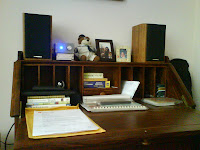 The tone I am hearing through the Pioneer Pure-Malts reminds me of my former Audio Note SORO SE (single ended) integrated and 300B Kit 1 power amplifiers. I could safely vouch that the sound quality of my modest second system now is even better with its immense clarity, abundance of micro details and PRaT (the fundamental aspect of music making) which most valve (tube) amplifiers are insipid and could only envy. Although musical instruments now sound extremely rich, the sound is very different from those which emanate from valve amplifiers – great transparency (as though a veil has been lifted off from the plane of sound), no valves' euphony nor smothering/masking of real tones. Amanda McBroom’s voice in her Dreaming album sounded course and powerful. So is Mary Black's No Frontiers album, as bright sounding as ever. Every other CDs decidedly sound better.
Due to my newfound listening joy, I listen less to my main system of late which I now find as lacking and may see some drastic overhaul. All of us do go through different phrase in life at different point in time and to which I am no different. I would need to ascertain whether I could do away with having a main system in my living area and only live with a small system (built around the Pioneer Pure-Malts and T-amp) and to contemplate disposing off the equipments lock, stock and barrel. For those of us who attend musical live events from time to time, it would be impossible for our hifi systems to reproduce the absolute scale and dynamics of those events. To me, quality should always prevail over quantity.
.
 I am no audio DIYer and have only a superficial understanding of audio electronics when I embarked on the DIY T-amp project. I have, however, built an Audio Note Kit 1 300B valves power amplifier in the past based on step-by-step instructions during which I learned how to use the soldering iron quite effectively, could differentiate between good joints from bad ones and also learned a couple of tricks. I have relied on online comments made by others who experimented with their T-amps before me and also acted on my gut feel in other areas to complete both my 2 units. I have owned and listened to numerous amplifiers in the past, yet I am still thoroughly charmed by the T-amp’s sonic qualities. Read about my listening to the DIY T-amp.
I learned a lot from the T-amp project and my findings and/or rationale of some of my actions are as follow:
(1) Input capacitors – The primary reason for their presence on the T-amp is to block DC current while allowing AC (Audio) signals to pass at the input line. I had initially thought they were only meant for signal filtering just like signals into individual loudspeaker drivers. The explanation by Blair Thompson, aka Justblair at the bottom of this article is a good read.

 The input capacitors affect sonic qualities of the T-amp most as a change in these capacitors would make it sound very differently. Some folks went on to claim an improvement in resolution and soundstaging capability of their T-amps after using certain capacitors. In my case, I opt for moderately-priced metalised polyester film capacitors of Vishay Roederstein MKT1813 2.2uF 63V and Vishay Roederstein MKT1822 2.2uF 100V which are available at RS Components/Farnell in my 2 units of T-amp instead of exotic boutique ones. Of the two, I prefer the former more as its sound is much more relaxed, open-sounding, sweet and velvet-like. An article on capacitor test which include the Vishay MKT1822: http://www.humblehomemadehifi.com/Cap.html
We could try out any other capacitors between 1.0uF to 3.3uF so long as they could fit onto the T-amp boards. The use of capacitors with higher capacitance value though will lead to 'thud' sound during powering up.
 (2) Power filtering/buffering electrolytic capacitors – Low ESR capacitors should be used here and many folks have reported a more dynamic, more punching solid bass to the sound of T-amp after a change to these capacitors. I opt for Panasonic FM series 470uF 25V ones.
I discovered that the ideal value of these capacitors on the T-amp should be 470uF 25V by accident after listening to my colleague’s unit on 27.09.2008 while we were troubleshooting a soldering-induced problem on his board. I had listened to and compared both our T-amps whereby mine has the 4 stocked capacitors replaced by Vishay MKT1813 2.2uF 63V axial type polyester film capacitors and Panasonic FM low ESR 1000uF 16V electrolytics whereas my colleague only changed the input capacitors to the same Vishay MKT1813 capacitors. Mine is also with a 24-steps 50K Dale resistors attenuator whereas his an Alpha 50K carbon potentiometer. PSU used is a 12V DC 2.5A SMPS, source a Sansui CD-X310 and transducers Q Acoustics 1010. I had reported at LYN forum that the difference in sound of our T-amps as very substantial and initially preferred the unit with Panasonic FM capacitors. The overall scale of music and tonal balance sound larger and more balanced respectively, the low frequencies also carry more weight which adds to the foundation of music making. I had concluded that the stocked buffer capacitors of 220uF 25V must be replaced, inferring that my choice of Panasonic FM 1000uF 16V is correct.
An afterthought to what I had reported earlier - upon further reflection, I found that Vishay MKT1813 capacitors when paired with the stocked buffer capacitors of 220uF 25V produce a livelier highs and midrange. Vocalists sound more airy and micro details are more easily picked up, the very feeling which evokes goose bumps in us (the very hallmark of TA2024 chip itself). With Panasonic FM capacitors on board, the image is bigger and music carries more weight but some of the micro details are overshadowed by the dominant bass weight and a shift in tonal balance from yin to yang which could be a tad tiring over long period of listening. Perhaps, an in-between value used here may be desired so as to strike a balance and this could be reason why finished T-amps usually come with low value capacitors in the buffer section. It was after my listening to the newer board with stocked 470uF 25V presumely general purpose capacitors in buffer section which confirmed that it has indeed more micro details than my well run-in old board and sufficient bass weight although a little flat in comparison to my old board, possibly attributed by the absence of discrete resistor-type attenuator.
 (3) Volume potentiometer – I opt for a 24-steps 50K Dale discreet resistor type attenuator for use as volume potentiometer instead of carbon type like Alps RK27 Blue Velvet as my past experience with Audio Note Kit 1 power amplifier clearly demonstrates that the former gives a far more transparent sound, better tonal balance, 3 dimensional soundstage and a killer midrange (tone and body) to-die-for over the latter. I had fitted onto the said amplifier a surprisingly cheap 100K Alps Blue resistor type potentiometer (its construction similar to present day TKD resistor potentiometer) that did not last very long and was replaced with a 100K Alps RK27 carbon type potentiometer shortly thereafter. Consequently, I lost the body and liquidity of midrange that I cherish.
I am often fascinated by the pursuit of others for transparency and musicality through the use of discreet resistor type attenuators in passive pre-amplifiers. Some interesting sites: http://www.eastmarinedrive.com/contents/non-static/passive-content.htm; and http://www.mh-audio.nl/MySystem/hifi.asp.
The selection of resistance value for volume potentiometer is dependant upon the input impedance of T-amp and some folks have also reported much success with 20K ones. With higher resistance value, the entire range of the volume potentiometer would be playable without the T-amp sounding way too loud. For more information, see: http://www.goldpt.com/info.html.
(4) Surface mount devices (SMDs) - I am of opinion the SMDs on my T-amp boards are of inferior quality and value of some are not according to those specified in the Bill of Materials. Replacing these with better grade ones or discrete components should improve sound of the T-amp. An article on understanding and working with SMDs: http://www.geocities.com/vk3em/smtguide/SMT-GuideV1-3.PDF and a YouTube video: http://www.youtube.com/watch?v=3NN7UGWYmBY&eurl=http://www.curiousinventor.com/guides/Surface_Mount_Soldering/101
(5) Internal wires – I only use very cheap AWG-26 multi (7) strands copper wires which cost me RM0.30/metre for internal wiring of my 2 units of T-amp. I have braided the single run of wires for signal just like those from Kimberkable PBJ interconnects with no shielding so as to filter out stray RFI (Radio Frequency Interference) picked up with 'Capacitive Cancellation' phenomenon by the crossing of wires in the cable. I have personally heard the PBJ sounded so much better than its shielded version of KC1 and also the tone richness of SilverStreak that PBJ clearly could not match let alone the full silver KCAG but as I am only using a short length of less than 9" in total, I opt for copper instead of silver which I thought is more suited to the sonic character (see Summary below) of the T-amp. As for the wiring to speaker binding posts and 12V DC, I have twisted and used the same wires in double run instead of thicker wires.
(6) Light Emitting Diode (LED) – I installed a blue coloured LED each to both units of my T-amp, tapping from the 12V DC input which powers the board and wired it parallel. A LED needs a resistor connected to its anode (+ve) leg so as to limit the current passing through. From the calculation, a 1W 1K resister is adequate for 12V application but in reality, we may need a higher value as the LED is merely for pilot light and need not be overly bright. A self explanatory article: http://www.kpsec.freeuk.com/components/led.htm
 (7) Switched mode power supplies (SMPS) - I have been using a RM33 12V DC 36W 2.5A computer-notebook-style SMPS all along. I had originally wanted to get another similar unit as I have 2 units of T-amp but my colleague convinced and bought me a Meanwell S-50-12 SMPS for RM55 on 11.11.2008. The difference in sonic quality is substantial and the extra amount of money spent is well-worth. Coincidentally, size (width and depth) of this SMPS is identical to casing of my main T-amp and looks very much the dedicated external PSU specially made for it.
The Meanwell S-50-12 SMPS has 4.2A on tap and its DC voltage could be increased to 14V maximum. Even at 12V setting, it sounded so much better than my other SMPS – the sound becomes fuller, more 3 dimensional and the amplifier behaves like a 50W instead of a mere 20W. It is less flat-sounding and less tiring over long period of listening with ample of reserves when demanded upon. A really excellent stuff.
The wiki of diyAudio.com (http://www.diyaudio.com/wiki/index.php?page=Class+D+Amplification) states that 3A – 5A regulated supply is typically aplenty as the T-amps only draw about 300mA with a musical signal, with many loudspeakers. Even when a battery is to be used, its recommended amperage-hour is 7Ah. I would think the T-amp does not only draw 300mA constantly with musical signal all the time as very loud and complex music passages with lots of bass will definitely draw more current. And with difficult load loudspeakers (their impedances dipping very low), the T-amp will require even more current. With the T-amp driving medium sensitivity loudspeakers of benign loads and music not being played to head banging levels, 4.2A should be more than sufficient.
In my opinion, SMPS is cheap, convenient and the Meanwell is with flexibility of switching to a slightly higher DC voltage. Apart from SMPS, there are the linear power supply and 12V DC 7Ah batteries. On sonic quality of using these different means to power up the T-amps, do check out comments by a reviewer who has used all three to power his T-amp: http://www.tnt-audio.com/ampli/amp-6n_e.html
Summary: The TA2024 chip is designed primarily by the now defunct Tripath as a multimedia amplifier, its main characteristics - ultra clean sounding and prominence to the highs and upper midrange. Bass is slightly lacking. Use of suitable valued low ESR electrolytic caps would restore the balance slightly (I found success with Panasonic FM 470uF 25V ones). Replacing SMDs with discrete components and/or using a full resistor attenuator will further 'cure' the ultra clean sound and render the T-amp slightly more 'dirty', colourful and musical. A few of us have heard a T-amp board with most of its SMDs replaced with discrete components, its sound as what I have ascribed. We also heard how the Vishay MKT1813 2.2uF 63V metalised axial caps made the T-amp even more musical, especially in the midrange. All harshness and hardness from the stocked input caps were totally eliminated.
 What am I on now? I have joined a fellow forumer at LYN in performing a ‘mad’ modification of removing all the SMDs and replacing them with discreet components (completely ignoring the benefits of the former over the latter) in the hope of milking the very last bit of performance possible from the T-amp.
I appreciate Justblair’s mention of my review of the T-amp at Post 621 in a diyAudio forum on Sure Electronics board (http://www.diyaudio.com/forums/showthread.php?s=7baaed79463029223d2c822c871e5fc5&threadid=112395&perpage=25&pagenumber=25) and his website (http://www.justblair.co.uk/blog/12-audio/27-welcome-to-malaysia.html).
I have in the evening of 04.10.2008 installed a flag counter to provide me with an indication of number of visitors to my blogsite and must say I am deeply honoured to have close to 50 people from all over the world visiting it within the first 24 hours.
Justblair's explanation on input capacitors:
"... The best solution is to have no capacitors in a circuit altogether. However, the capacitors have a very useful property in the sense that they block DC signals while allowing AC signals (ie Audio) to pass. To understand how, look inside the capacitors. There are two layers of conductor, separated by a very thin layer of insulation. What happens when electrons are removed from one side than the other (ie a positive charge) is that electrons on the opposite layer are attracted to the positive charge, they flow in.
. Of course when enough have flowed in, they stop, and we have no current, ie the DC current has been blocked. Add some electrons to the now positive side, and the electrons on the other side will no longer be in balance and will flow away from the plates until equilibrium is now reached. Remove them again and the opposite occurs. What is happening now is that the AC signal occurs on the other side of the capacitors as a reaction to the AC signal on the source side, or to put it another way, AC signal has been allowed to pass.
. The fact that we get a filter this way is almost consequential. If we want the amplifier to feed a high range speaker we could use very small input capacitors to restrict not just the DC but also the slow charging AC (lower frequencies). Capacitors also filter low frequencies apart from DC current. It has to do with the charging and discharging times. That is where the resistor comes in. It reduces the current, meaning the capacitor takes a finite time to discharge and recharge. If the frequency of the signal is low enough, it changes aptitude (voltage) more slowly. The capacitor discharges quicker than the change in source signal, so the source signal does not pass through..."
Added on 12.12.2008:
 I have finally completed the modification of replacing the entire SMDs with discrete components on my third T-amp board on 04.12.2008 after acquiring an Antax 18W fine tip soldering iron. This T-amp board subsequently found its way into the casing of my first T-amp pictured above. The replacement discreet components and their respective costs (all from Farnell) used on my third T-amp board are as per below:-
Vishay Roederstein MKT1813 2.2uF 250V caps (2) - RM14.66 ;
Panasonic FC 470uF 25V electrolytic caps (2) - RM4.82 ;
Vishay BC 0.47uF 63V caps (6) - RM15.84 ;
Vishay BC 0.1uF 63V caps (6) - RM7.02 ;
Vishay BC 1000pF 400V caps (4) - RM2.68 ;
Vishay BC 100pF 50V caps (2) - RM2.58 ;
Panasonic Audio Grade 1uF 50V electrolytic caps (2) - RM1.90 ;
Vishay BC 1% Metal Film 20K ohm resistors (4) - RM1.68 ;
Vishay BC 1% Metal Film 10 ohm resistors (2) - RM0.84 ; and
Vishay BC 1% Metal Film 8.2K ohm resistor (1) - RM1.48.
Total: RM53.50
.
If electrolytic caps are to be used (I myself use such Panasonic 1.0uF caps in C5 and C17), their polarity must be observed. A better way to mount the resistors on the T-amp board would be to let them stand vertically instead of being horizontal as in my case. I could hardly find enough space to mount them in R9 and R10 so much so that I need to remove the 10 ohm resistor after having soldered it properly and in the process accidentally lifted the soldering pad of R9 bottom and ended up having to tap its leg to the blotch of solder below C28 bottom. Please exercise care and do not solder and desolder many times as the soldering pads could come out quite easily. If the power buffer caps are to be replaced, the stock caps should to be removed prior to the soldering in of the discrete components.
This modification is rather 'mad' as I put in discrete components onto a T-amp board meant for SMDs. It took me 6 hours to complete my entire modification but I feel the outcome to the sound changes of the T-amp totally fantastic, no regrets. Most important of all, at the end of day we are using it to listen to our music. On its sound quality, after playing music for many hours now, it is beautiful and easily some 20% better in all areas (resolution, airiness, decay, expressiveness, micro details, timing, 3D soundstaging, dynamics and even dynamic shadings) in comparison to my 1st board. As I am using a discrete attenuator rather than a carbon type volume pot, I find the high frequencies extended yet not bright sounding to the extent of being unforgiving as reported by a LYN forumer. Total cost for replacement discrete components is RM53.50, almost the price of 1 T-amp board. However, to me, the mod is well worth every sen spent so for those who could handle the soldering iron reasonably well and are deliberating whether to perform the mod or otherwise, my advice would be to go for it and tell me later if I have been incorrect in my assessment. I would even go further to pronounce that my T-amp with full discrete components will take on and give many highend amplifiers a run for money. What it could not produce in quantity (huge wattage) is compensated by the sheer quality it oozes.
A week after I completed the modification, the sound of my T-amp with discrete components is very different from the time it was newly done. I have used bigger than usual capacitors (Vishay Roederstein MKT1813 2.2uF 250V in the input stage and Vishay BC 1000pF 400V in the output biasing stage) and a result of this is my T-amp sounds so much more smoother and fuller. Absolute speed is just a tad slower compared to my other units of T-amp with SMDs or even another LYN forumer’s unit where most SMDs were replaced with discrete components. I have not installed any additional PSU cap(s) so as to maintain the same level of 'micro details' and overall balance of sound. I thought its timing now is almost perfect. I also hear no noise nor distortion after replacing the SMDs with discrete components but I must admit that the super clean and almost clinical sound of the stock T-amp is now gone. Could whatever distortion induced be the 'even-order harmonic distortion' which are so pleasing to our ears? Yes, you got me correctly, I am inferring that my T-amp with full discrete components is sounding pretty close to a valve (tube) amplifier not only in its smoothness, warmth and micro dynamics but also with its timing gotten right, lots of rhythmic bounce and sufficient bass and bass weight we could possibly seek from an amplifier. Shocking, but the sound of my modded T-amp is that good and extremely transparent at such a low price without any use of fancy powercord, interconnects or speaker cables.
I am certainly not the only guy to have raved that the T-amp sounds pretty close to a valve amplifier as many others have actually indicated their preference of T-amps over their other exotic valve amplifiers. Enjoy tweaking and listening.
.
 I have finally assembled my own T-amp today (06.09.2008) although it is still yet to be fitted into its wooden casing (which needs more time to complete as its sidewalls are very thick and require some chipping away of wood beneath the 10 manually drilled holes). I made a power wire with some AWG-26 multi strands wire (doubled and twisted per side) soldered to a DC male connector for use with a computer-notebook-styled 12V DC 2.5A SMPS (switched mode power supplies). I then proceed to de-solder out the 3-pins input connector from the PCB board, thoroughly sucked away all the stale solder and cleaned the 3-holes area with thinner before soldering in a pair of Neutrik RCA-plugs plus a 50K (Dale resistors) 24-steps attenuator.
 I connect the T-amp to my Q-Acoustics 1010 bookshelf loudspeakers (sitting directly on the wooden flooring) with some el-cheapo hotwires. Source is a sub RM200 mass-market LG DVD player. After ensuring all connections are proper, I powered up the T-amp, hit the play button on the DVD machine and waited eagerly. No sound, the whole setup is dead quiet, no hum, no buzz – either a very good sign or I may have wired-up the amplifier wrongly somewhere. Momentary suspense. I cranked up the volume and now the sound comes about, softly at first but gradually gets louder as I turn the knob of the attenuator. Great!
What did I hear?
- Initial impression is a well-defined and clean sound with highs a little lacking and some boom to the lower mid / upper bass region. Clarity is good but nothing spectacular as yet.
- Midway through playing the third CD, I began to notice both macro and micro dynamics have improved substantially with great swing from the quietest to loudest passage. The forceful rendition of voice by a female vocalist, sound of her breathing and her lips parting come out so well pronounced.
- Playing the fourth CD (a female vocalist rendering some 90s pop songs in jazz style), timing and rhythmic swings are thought to be great. Sibilance associated with this CD is almost all still there. But hey, wait a minute, bass digs deeper now with less boom than earlier.
- Tonality / tonal balance and timbre of acoustical instruments are thought to be good. Liquidity of vocals, a sign of great midrange, however, could not be attained, probably a limitation of CD playback through a DVD player rather than by the T-amp.
- Size of image is big, I have yet to position my loudspeakers properly to try out the 3-dimensional sound staging capability of the T-amp. Currently, they are positioned 3 feet apart from one another and each of them sits on a stack of magazines. Within this setup, I hear the T-amp images well, vocals well fleshed out (as opposed to cardboardy sound) with decent sound stage and depth. I would think the sound staging capability would not be any lesser than most other amplifiers and shall comment once I have fitted my T-amp into its casing proper and after listening to it in my main hifi system.
- Details through the T-amp playing at moderate level is good; sound of people talking, glasses clicking and cash register at the background of beginning of Limehouse Blues of Jazz at the Pawnshop 1 come out crystal clear. (When this track was played through a mid price Marantz integrated amp few years’ back, an acquaintance had sarcastically enquired whether we were actually listening to silent music!) Listen also to the ending passage of Randy Crawford’s Diamante to a dog barking and sound of waves hitting on shores in the background of Priscilla Chan (陈慧娴)'s 痴情意外.
- Bass – a lot of energy in this region but its definition is rather vague at this juncture; the T-amp certainly needs more hours to be run-in. However, I must admit with good recordings, definition of bass is all there and well defined.
- Treble – Clean and extended yet not harsh nor ragged sounding.
- Overall, the T-amp is sounding much more musical and relaxed now after 8 hours of playing music non-stop compared to when it was just powered up for the first time. Its well-timed rhythmic swing and slightly forward sounding midrange certainly makes listening to music through it addictive enough for me in not wanting to stop listening to more. I am listening to Jazz in the Pawnshop now - great music sounding even better through the T-amp. And I thought it sounded pretty close to analogue (a fellow forumer at LYN reminded me I was actually insulting the digital medium!).
 My T-amp has clocked approximately 20 hours by now (07.09.2008); still a long way to go before it is fully run-in. It now sings much better and sounds more beautifully than yesterday and by right I should have just left it alone to continue singing. However, the curiosity to tweak got the better of me and armed with my soldering iron, I removed the 4 capacitors on board. I replaced the input capacitors with a pair of Vishay Roederstein MKT1813 2.2uF 63V Metalised Polyester Film Axial Type capacitors and as for the buffer capacitors, with a pair of Panasonic FM 1000uF 16V electrolytics.
 How did the change in capacitors affect the sound of my T-amp? I shall come back to this shortly after describing the bookshelf loudspeakers that I paired with my T-amp. Q-Acoustics 1010, to me, have almost perfect highs and midrange which are seamlessly integrated and at their selling price, are second to none. Their weaknesses though, are they do not have any ‘real’ bass to speak of and they do not throw a big soundstage like many other loudspeakers. Being a midrange guy, I could easily live with such shortcomings.
I had initially placed the pair of loudspeakers sitting directly on the wooden flooring in my bedroom but after a couple of hours of listening to music through them on Saturday afternoon, my ears could no longer take to the hard and ‘overpowering’ bass I was getting from them so much so I inserted a stack of magazines under both loudspeakers. I had also mentioned with normal recordings, bass definition of T-amp was a little vague.
Immediately after the capacitors change, I only detected subtle differences. First, the hardness and ‘overpowering’ bass I was hearing through the stocked capacitors are now gone. Bass is now softer with bass lines slightly better defined (less of the mini-compo effect in bass I thought I was hearing at times earlier). I thought this is how my Q-Acoustics 1010 should actually sound.
I also thought the highs now sounded more refined and slightly airier and midrange especially in vocals sounded less forceful than before. Is it a good thing? Hmmm ……
Previously, I had asked whether the midrange and highs of my T-amp are really better after the capacitors change by me. I have listened to several more CDs since then and my answer now (08.09.2008) is a resounding YES. Vocals sound airier, livelier and less forceful (hardness in midrange greatly reduced). I would think a CD player proper is required in my setup to totally remove any hardness remaining. The overall sound now is a touch more gentle compared to before.
A CD I used of late to test vocals and resolving ability of amplifiers is Il Divo’s first album (Sony BMG 828766765427) where 'Unbreak My Heart' is the first track therein. This is a non-audiophile CD and I only owned a local-pressed copy. With most amplifiers, this CD would sound rather noisy as Il Divo is a group comprising of 4 male soprano singers brought together by Simon Cowell (yes, the outspoken judge of American Idol). After the capacitors change in my T-amp, Il Divo sounded extremely close to what I am hearing through my Simaudio Moon i-3 integrated amp and this is really stunning as the resolving ability of my T-amp has now surpassed that of Exposure 2010S integrated amp, a Stereophile Class A component currently retailed at RM4,300 in our country.
In concluding my review, I would say even in its stocked form, the T-amp kit (TA2024 chip) at RM55 (throw in another RM100 or so for some decent RCA plugs, speaker binding posts, wires, a volume potentiometer and casing) is a well-designed amplifier which sounds great and in fact a giant killer. It would easily surpass the sound quality of many entry level integrated amplifiers, my former Sony TA-F5000 (with some very good Japanese internal parts) included. If any of us are on the lookout for an amplifier, it would be almost a sin not to explore and consider picking up the T-amp. And after some modifications which include the change in input and PSU capacitors plus others (change in critical SMDs to decent-grade capacitors, resistors and inductors), its sonic qualities should be raised to even greater heights, the sound after that surpassing many mid-priced integrated amplifiers. Many of us would be pleasantly surprised, charmed and could live happily-ever-after with this little gem.
added on 16.09.2008: I replaced the LG DVD machine with a RM300 NOS Sansui CD-X310 CD player in my T-amp system on 11.09.2008 and after some 30 over hours of running-in the CD player by playing music, the system is sounding really marvelous. My tiny Q Acoustics 1010 (86dB/1W/1m) loudspeakers do not sound like small loudspeakers at all as I am getting lots of bass both in quantity and quality (goes very deep) and overall, a relaxed yet extremely dynamic, expressive and high on PRaT sound and the system certainly is giving my main system a run for money and in fact better in certain areas.
Which areas, you may ask? It is the directness, expressiveness and micro dynamics …that magical thing that it's hard to put a finger on. Magic is about as close as I can come to describing it. The sort of thing that triode lovers rave about although they don't really sound like triodes.
Listening to Nigel Kennedy performing Vivaldi's Four Seasons (EMI 724355635328) would easily endear the tone of his violin, mood and totally different interpretation of these pieces. And certainly not all affordable amps or systems could attain this!
 A class T amplifier is an audio amplifier which uses Tripath (since insolvent) chip based on Class D topology instead of being a different class of amplifier. It is a high order switching chip amplifier that uses a spread spectrum PWM technique to generate the audio output. This output is then filtered through a simple second order low pass passive filter to remove the ultrasonic switching residue and leave the audio signal to be sent to the loudspeakers.
I have come across numerous rave reviews on class T amplifiers and that their excellent sonic qualities far exceed many other amplifiers costing 100 times their price. Review 1: http://www.stereophile.com/solidpoweramps/1006sonic/ Review 2: http://6moons.com/audioreviews/trends/ta10_2.html plus many others. Nothing transpired and this information only remained at the back of my mind until the recently concluded KLIAV Show 2008 where I finally got to hear a class T amplifier myself. It is an amplifier in wood casing named Charlize with Tripath TA2020 chip (max output of 10W into 8Ω / 20W into 4Ω) driving a pair of horn speakers in diyParadise room. I thought to myself how natural the sound was.
I gathered more information at diyParadise and diyForum websites and even chatted with Yeo as I was keen to buy an unit of Charlize in kit form for RM350 (diyParadise also sells Charlize as finished product for RM1,000). I like the idea of assembling my very own Charlize in a small wooden jewellery box just like what was featured in their website but with RCA connectors and speaker binding posts fitted in more properly instead of them sticking out midway from the wooden casing. Just before I could place my order, I chanced upon another class T amplifier also in kit form but uses Tripath TA2024 chip (max output of 6W into 8Ω / 11W into 4Ω, both ratings @ 0.10% THD) being retailed at a hard-to-resist price of RM55. Given its price, I thought the capacitors and resistors must be of inferior quality which may need to be replaced for this class T amplifier to really sing properly. I have since ordered this kit and would need to listen to it with my loudspeakers to assess whether the 11W output is sufficient for my applications before I replace any of its components. I hope not to go overboard and work within my original budget of RM600 for the finished amplifier.
The TA2024 is a stereo bridged amp. This could be seen from the schematic in the dual push pull transistors for each channel and the 2 sided output filters. The chip is designed to run off 12V DC, so the bridged mode is needed to squeeze more power out of the 12V. It cannot be bridged further. Most of those who have written about this amplifier rave about its sound qualities, often comparing it favorably to valve amplifiers. What is the difference of TA2024 from Charlize (TA2020)? I have only heard Charlize once and never did any direct comparison between the two but after reading the comments of many others who have written on these Tripath chips, TA2020 seems to have a smoother, fuller sound and a bigger soundstage than TA2024. There is also slightly more power from TA2020 before clipping. TA2024, however, is the winner for micro details, the magical thing that valve amplifier lovers seek.
 What would I be driving my class T amplifier (hereinafter referred to as T-amp) with? Most probably a pair of 86dB/1W/1m Q Acoustics 1010 bookshelf loudspeakers that I picked up during KLIAV Show 2007 meant for my second system in the bedroom/study although I also have another mint pair of audiophile loudspeakers in Epos m5. I only intend to set up a small system for nearfield listening with no intention for yet another hifi system as I already owned a decent-sounding system at home which I enjoy listening to immensely. Listening to my main system has always put back a smile to my face whenever I am feeling a little down from work pressure.
After I sold off my Sony TA-F5000 integrated amplifier, I had always fancied buying a Musical Fidelity X-80 (40W) integrated amplifier for my bedroom/study because of its looks and small footprint. Sonic quality is decent. The local agent, LTB Enterprise has some brand new units but still maintained their selling price at RM3,200 each, too pricey as far as I am concerned. I then lowered my choice to a NAD C315BEE integrated amplifier but felt its sound is a little too harsh to my ears and its full equipment size rather unsuitable. All these until the T-amp came along.
I have maintained in LYN forum from day one even before I received my first T-amp board that I am not expecting it to sound as good as the resident amplifier in my system. My first T-amp fitted with a discrete attenuator actually sounded very good and far exceeded my expectation so much so I later built another unit for my office. I am quite a perfectionist and have taken great pain to select the peripheral parts and assemble both my T-amps. Read about my listening to the T-amp where I have dedicated a separate article on it. An interesting article where TA-2020 chip based T-amp is built DIY, detailing parts used, the process and rationale: http://ta2020.huuryuu.com/index_e.html Further thoughts: If only the JVC SX-WD1KT wood cone single driver loudspeakers could be gotten at a more affordable price, I am of opinion that these are even better suited for my T-amp based system for my bedroom/study. The system would probably be the only system I ever need to accompany me to my sunset years if they could last that long.

 The tone I am hearing through the Pioneer Pure-Malts reminds me of my former Audio Note SORO SE (single ended) integrated and 300B Kit 1 power amplifiers. I could safely vouch that the sound quality of my modest second system now is even better with its immense clarity, abundance of micro details and PRaT (the fundamental aspect of music making) which most valve (tube) amplifiers are insipid and could only envy. Although musical instruments now sound extremely rich, the sound is very different from those which emanate from valve amplifiers – great transparency (as though a veil has been lifted off from the plane of sound), no valves' euphony nor smothering/masking of real tones. Amanda McBroom’s voice in her Dreaming album sounded course and powerful. So is Mary Black's No Frontiers album, as bright sounding as ever. Every other CDs decidedly sound better.


