I've been listening a lot more to my
modest bedroom system of late that I find sonically addictive with its spot-on
timbre, great timing and explosive dynamics. It comprises of none other than my
Pioneer pure malt speakers being driven by a Rotel RA-04 integrated amp with a
Rotel RCD-06 se cdp as front end. Cables are diy silver interconnects and short length of Chord Carnival Silver Plus.
I've raved greatly on the excellent sonics of LP playback
in several of my blog postings but fact remains that I embarked upon my audio
odyssey with Redbook CDs and it'd be folly to completely ignore the great music
found in some 300 odd CDs which I acquired over the years, some having gone
through real great pains to do so. I've since tweaked my main system with better-suited cables
but its overall sonic characters remain fundamentally unchanged. Perhaps I
should consider finetuning my amp's bias next for it's still a little
uninvolving especially with CD playback although it has excellent clarity, sounds utterly rich, paints a solid
3-dimensional soundscape with precise location of vocalists/instruments,
portrays a humongous soundstage plus a fabulous midrange to die for. It's great
with vocals but as for other genres of music, it’s a little too suave, a little too
refined and a little too restrained, dynamically.
Enter my bedroom system. My Pioneer pure malt speakers are
extremely rich sounding (much richer than my SF Concerto Home) and although its
sensitivity is only 84dB/1W, its load impedance is rather benign and could be
driven well by any medium powered amp. I opted for the relatively lean, raw and
extremely dynamic sounding Rotel RA-04 int amp rated conservatively at 40W @
8ohm. An under-rated entry level but a real classic little amp that could be had rather
cheaply, this amp has no nasty remote control circuitry that degrades sonics
and the ideal configuration in number of output transistor caps. I've recently
added a Rotel RCD-06 se cdp replacing my good old Sansui CD-X310. Sonically,
it's a class above the latter with its better-endowed midrange and greater bass
weight. Internally, a Wolfson WM 8740 DAC graces the pcb instead of the older
Burr Brown DACs. Rotel has since ditched the Pacific Microsonics HDCD chip that
results HDCD-encoded CDs to sound fabulous but mediocre with ordinary discs.
I'm currently re-discovering classical music in my LP/CD
collection. To me, they simply have more substance and are more satisfying,
musically. Through my Rotel combo, every note/shift in tempo is clearly audible,
music becomes so alive, there are plenty of rhythmic bounces and its dynamics
approach a high level of realism. Playback of piano sonatas sound convincing enough,
akin to listening to a Kawai piano at home. This is truly terrific and exceeds
what I could possibly have bargained for, what more with entry level gears.
It's the music sounding great that matters, not the hi fi gears themselves. Did
I also mention that the Rotel amp has a very decent inbuilt phono stage
considered equal to a Goldring PA-1 phono?
 My first encounter with Pioneer S-A4SPT-PM Pure-Malt loudspeakers was two years ago. I first knew about their existence from the internet and got myself pretty excited prior to seeing the physical units. I saw them later during The KLIAV Show 2007 and like their looks a lot but had thought that their sound, being driven by a Pioneer integrated amplifier, was nothing really to shout about. I was sure of attaining better sound from them and had craved to own a pair of these 'unique' loudspeakers but their retail price in Malaysia deterred me. I persevered and it paid off for today I picked up a brand new pair of these loudspeakers at a fraction of their earlier asking price.
The Pure-Malt loudspeaker cabinets are made from recycled white oak hardwood from retired barrels used for ageing malt whiskey for 50 – 70 years instead of MDF boards laminated with wood veneer or vinyl. The malt whiskey barrels were in turn made from oak trees of 100 years' old. For Pioneer's eco-friendly efforts, the Clean Japan Centre awarded the loudspeakers a resource recycling technology prize. The accompanying sheets state that the recycled white oak hardwood provided by Suntory Limited Corporation "makes a surprisingly rich bass sound, maximizing speaker drivers’ performance, and representing the richness of the music" by suppressing unwanted reverberations.
The loudspeakers are small, with their cabinets measuring roughly 10"(h) x 6"(w) x 8"(d). I love handcrafted hardwood furniture and find the loudspeakers well-made and full of character. Each cabinet carries a different serial numbers and is different with its own unique look due to the individuality of wood staves (may even have nail marks or whiskey stains) pieced together to create the cabinets.
Listening impression – these 84dB/1W/1m loudspeakers actually have some decent bottom extension from their small 4" woofers although they are mated to none other than my 10W TA2024 T-amp with full discreet parts and a attenuator. I am not too bothered with their low sensitivity as I am aware that what is more important is their measured impedance and relative easy (flat) load to amplifiers. As I listen to them nearfield at moderate level in my study, they sound extremely rich, highly expressive and detailed with a lush midrange and warmth although fresh from their boxes.
Do allow me to digress a little: I recently performed yet another sound shoot-off between my T-amp with full discreet parts and attenuator against an unit where only its input and PSU filtering capacitors are replaced with Vishay Roederstein MKT 1813 2.2uF 63V and Panasonic FM 470uF 25V respectively and fitted with an Alpha 50K linear volume potentiometer. The overall sound of both T-amps were very much alike but upon closer scrutiny, the other T-amp sounded brighter and has a tendency to over-emphasize the upper midrange and lower treble which creates a rather lean midbass. Overall bass is lightweight and soundstage although wide was flat. The use of attenuator over linear potentiometer rendered the sound less bright but with its highs more extended and bass fuller. There is more body to sound which is more transparent, more expressive in term of micro dynamics, has better macro dynamics and a 3 dimensional soundstage. Its (attenuator) use in T-amp with SMDs results in a rather dulled and blurred sound. The discrete parts restored the clarity and details much needed.
Coming back to the Pioneer Pure-Malt loudspeakers. Stereophile's review (http://www.stereophile.com/thefifthelement/1207fifth/index1.html) concludes that these loudspeakers are only fine but not great sounding and the reviewer does not see them being the center of someone's sole serious stereo. Huh! As much as I would agree that their diminutive size would restrict the ability to be played loud to the SPL required in the living area or a dedicated listening room, I beg to differ on their sound quality, especially in tone richness and timbre of instruments reproduced from CD playback. Violin, hard to be correctly reproduced through CD, sounds pretty close to the real thing itself through these Pioneer Pure-Malts. Piano sounds equally real and tone of these two instruments is not unlike that from vinyl playback, the very hallmark which pulled me towards it. Gone were the smeary and harsh high frequencies. A special mention must be made here with regard to tone of drum beats from track 9 of Usher test disc. The sound of skin of drum being hit is easily distinguishable and not woody nor the typical hard hitting sound which I am accustomed to hearing all these while. The PRaT, intensity and dynamics of sound from their small cabinets are amazing.
My Q-Acoustics 1010 have now been relegated to perform transducers' duty in the office.
Added on 03.03.09: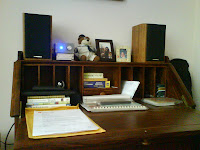 The tone I am hearing through the Pioneer Pure-Malts reminds me of my former Audio Note SORO SE (single ended) integrated and 300B Kit 1 power amplifiers. I could safely vouch that the sound quality of my modest second system now is even better with its immense clarity, abundance of micro details and PRaT (the fundamental aspect of music making) which most valve (tube) amplifiers are insipid and could only envy. Although musical instruments now sound extremely rich, the sound is very different from those which emanate from valve amplifiers – great transparency (as though a veil has been lifted off from the plane of sound), no valves' euphony nor smothering/masking of real tones. Amanda McBroom’s voice in her Dreaming album sounded course and powerful. So is Mary Black's No Frontiers album, as bright sounding as ever. Every other CDs decidedly sound better.
Due to my newfound listening joy, I listen less to my main system of late which I now find as lacking and may see some drastic overhaul. All of us do go through different phrase in life at different point in time and to which I am no different. I would need to ascertain whether I could do away with having a main system in my living area and only live with a small system (built around the Pioneer Pure-Malts and T-amp) and to contemplate disposing off the equipments lock, stock and barrel. For those of us who attend musical live events from time to time, it would be impossible for our hifi systems to reproduce the absolute scale and dynamics of those events. To me, quality should always prevail over quantity.
.


